


Texas Republicans Draw Battle Lines Ahead of Primary Runoff
The battle lines in Texas Republican politics are now fully exposed in runoff elections across the state, from the race for the United States Senate all the way down to local county offices. As early voting begins, Republicans are facing a fundamental question about the future of the party and what conservatism in Texas is supposed to mean moving forward.
For years, Republicans in Texas were often grouped together under a single political identity. That is no longer the case. Today, there are clearly two competing wings of the GOP. On one side is the more moderate, establishment-oriented Republican faction, often associated with the Bush-era style of politics that emphasizes institutional stability, compromise, and strategic moderation. On the other side is the increasingly influential conservative populist movement that demands aggressive action on immigration, spending, cultural issues, and the exercise of political power without compromising one’s principles.
The divide is visible up and down the ballot.
At the top of the ticket, Attorney General Ken Paxton is challenging incumbent U.S. Senator John Cornyn in what has become one of the most important Republican primary battles in the country. Paxton has presented himself as a conservative fighter willing to directly confront the political establishment and push back against the left without compromise. His campaign has largely appealed to the Republican primary electorate that believes Texas Republicans have too often failed to fully deliver on conservative priorities.
Cornyn, meanwhile, has attempted to remind voters of his long record supporting President Donald Trump’s agenda in Washington. The senator has repeatedly highlighted that he voted with President Trump more than 99 percent of the time while Trump was in office. Still, Cornyn has long carried a reputation among many conservatives as one of the more moderate Republican senators in Washington, particularly after his involvement in bipartisan gun legislation following the tragic shooting at Robb Elementary School in Uvalde.
Both Paxton and Cornyn understand the power President Trump still holds over Republican primary voters in Texas. Each candidate has aggressively pursued Trump’s endorsement, hoping it could become the deciding factor in the race. As of May 19th, Trump jumped in to endorse Ken Paxton during early voting.
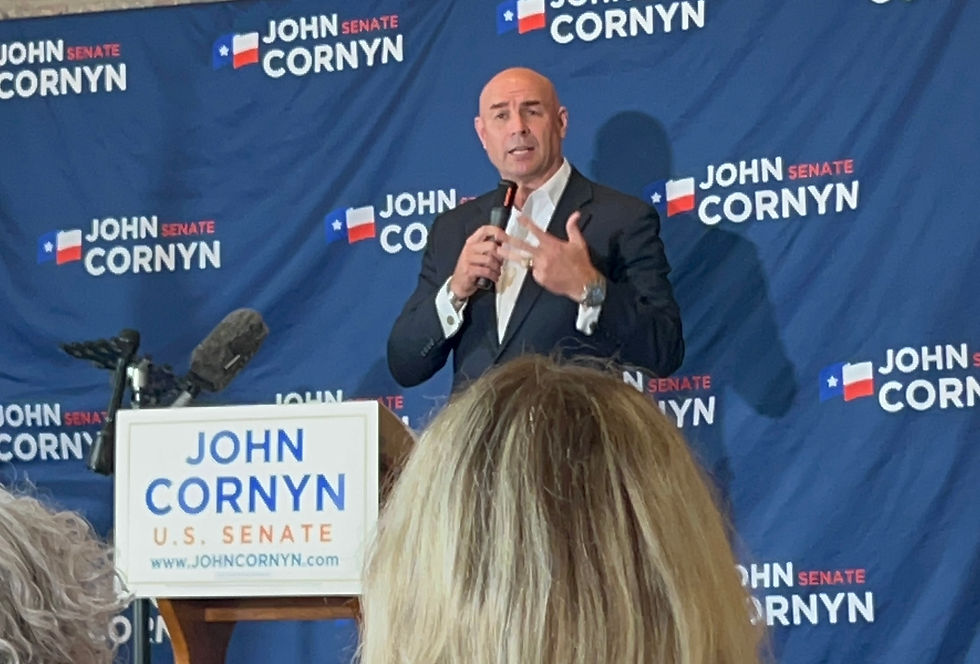
At a recent campaign stop in Waxahachie, Cornyn acknowledged the stakes of the election, saying, “this election is important because it will help determine the future of Texas.”
Republican voters are not simply choosing between two men. They are choosing between two fundamentally different visions for the Republican Party. One vision favors pragmatism and occasional bipartisan cooperation. The other believes conservatives must hold the line on principle and aggressively use political power to advance their agenda.
Cornyn’s appearance in Waxahachie also highlighted the broader coalition forming around the establishment wing of the Republican Party. Joining him at the event was Congressman Jake Ellzey, who has consistently developed a reputation as one of the more moderate Republican members of Congress from Texas since first being elected in 2021.
The Institute for Legislative Analysis rates Cornyn as aligning with the Republican platform only 69% of the time. That same scorecard rates congressman Ellzey as aligning with the Republican platform only 70% of the time. Both are firmly in the more liberal wing of the party.
Ellzey praised Cornyn during the event, saying, “I can’t think of a better man to represent us in Washington DC.”
He also took aim at Paxton and the conservative movement surrounding him, stating, “I really don’t understand sometimes how we choose a conservative who might have some issues.”
Those comments perfectly capture the philosophical divide now shaping Republican politics in Texas. For many establishment Republicans, electability and political stability remain top priorities. For the conservative grassroots, ideological consistency and a willingness to fight are often viewed as more important than maintaining institutional norms or media approval.
The same divide can be seen even in races down the ballot. Waxahachie is the heart of deep-red Ellis County, but it’s still a county divided along ideological lines.
In Ellis County, the Republican runoff for an open County Commissioner seat has become another proxy battle between the moderate and conservative wings of the GOP. Candidate John Paul Dineen has emphasized support from Congressman Ellzey, aligning himself with the more establishment-oriented faction of the party.
His opponent, Matt Zajic, has embraced the conservative grassroots movement and earned the endorsement of State Senator Bob Hall, who has become one of the most recognizable conservative figures in the Texas Legislature.
Speaking with American Liberty Media ahead of early voting, Zajic explained that he entered the race because Ellis County “wanted to see good conservative leaders.”
He argued that the divide within the Republican Party is undeniable, saying, “You absolutely do see the divergence between the more moderate-style Republican and the more conservative-style Republican.”
Zajic also expressed confidence that Ellis County voters would continue supporting conservatives at the ballot box. “Conservatives have done very well in Ellis County,” he said, pointing to Senator Bob Hall, former state senator Don Huffines, and State Representative Brian Harrison as examples of conservatives who have built strong support in the area.
For Zajic, the issue is not merely party affiliation, but the substance behind the Republican label itself. “We need conservatives like myself to step up and say ‘we’re going to spend these tax dollars wisely,’” he said.
Dineen did not respond to requests for comment from American Liberty Media.
As runoff voting continues, one thing is becoming increasingly clear. Simply calling oneself a Republican is no longer enough to fully explain where a candidate stands politically. Texas voters are now being asked to look deeper into voting records, endorsements, scorecards, and governing philosophies before casting their ballots. Election Day is May 26th.
The Republican Party in Texas remains dominant electorally, but internally it is undergoing a major ideological struggle that could shape the direction of the state for years to come. The question facing Republican voters this election cycle is not whether Republicans will lead Texas. It is which kind of Republicans they will choose, and if those Republicans will uphold the party platform.


Comments